“Caleb agrees.”
Those two words hurt more than the demand itself. Standing on the balcony of the beach condo I had bought with my own money, with the Gulf glittering blue beneath me, I realized my daughter-in-law wasn’t asking me to leave.
She was telling me I had already been replaced.
“I know the condo is yours,” Harper said through the phone. “But my parents want privacy, so you should go to a hotel.”
My fingers tightened around the railing.
This was supposed to be my one peaceful week of the year. Two days in, the tension I carried for everyone else had finally begun to leave my shoulders.
Then Harper called.
“My parents just arrived,” she explained. “They’ve had a stressful year. We want a few days alone with them.”
I waited.
With Harper, the real request always came second.
“So you should stay at a hotel for five or six days.”
Behind me were the ivory curtains I had sewn myself. The flower pots I had planted. The iron balcony table I had dragged upstairs because I refused to waste money on delivery.
“You want me to leave my own condo?”
“Don’t make this difficult, Barbara.”
Her voice softened—that careful, polished tone she used whenever cruelty needed to sound reasonable.
“Catherine and Richard are used to a certain level of comfort. You can stay somewhere simpler. You’re not that demanding.”
For a moment, I said nothing.
She wasn’t only asking for space.
She was reminding me of the place she had slowly carved out for me in the family.
Need less.
Take less.
Move aside.
Be grateful.
Then Harper said quietly, “This place will belong to Caleb eventually, which means it’ll be ours.”
My throat tightened.
“Ours?”
“We’re just being practical. Richard’s an architect. He already has remodeling ideas.”
Remodeling.
My home.
While I was still alive.
“There’s that budget motel off the highway,” she added. “That kind of place is fine for you.”
Something inside me broke.
Not into rage.
Into clarity.
For years, I had made excuses for Harper. She was direct. Strong-willed. Difficult sometimes.
But staring out over the water that afternoon, I finally saw the pattern.
She had been teaching me to surrender one small thing at a time.
And Caleb—my only son, the boy I had raised alone after his father left—had been letting her.
I could have argued.
I could have demanded he come to the phone.
Instead, I heard myself say, “Understood.”
Silence.
Harper clearly hadn’t expected that.
“Give me an hour to pack.”
“Oh.”
Then relief entered her voice.
“Perfect. I appreciate you being reasonable.”
She hung up without saying goodbye.
I walked slowly through the condo afterward, touching nothing.
The couch. The dining table. The kitchen where I still cooked Caleb’s favorite meals whenever he visited. The bedroom where fresh sheets waited for the one week every year that belonged completely to me.
Everything around me was mine.
And I had absolutely no intention of surrendering it.
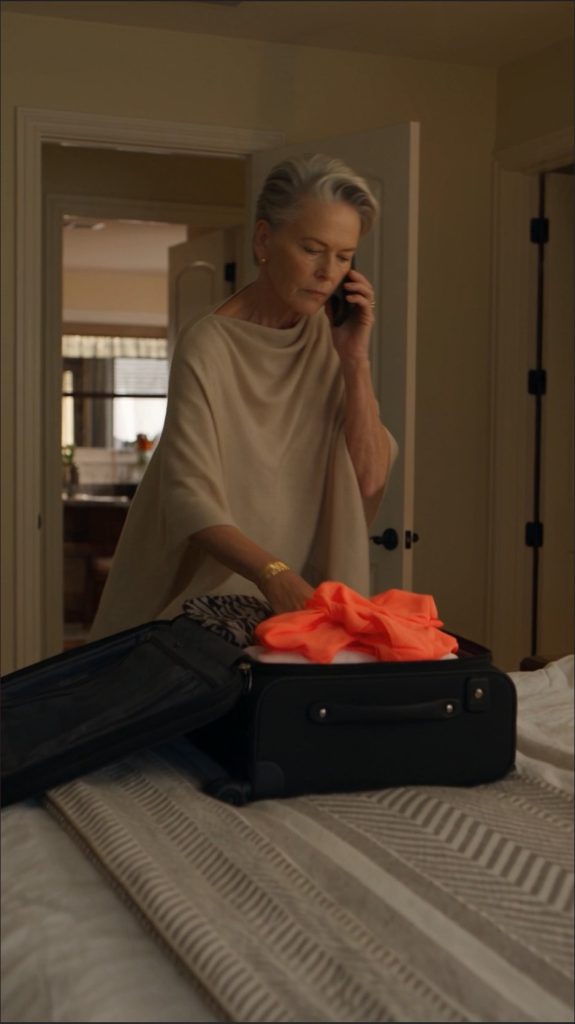
I pulled out my suitcase and packed just enough to make Harper believe otherwise.
Then I called Patrick.
“Barbara?” he answered warmly. “How’s the beach?”
“I need your help,” I said. “And I need this kept between us.”
His voice changed immediately.
I told him everything—the hotel, Harper’s parents, the remodeling plans, the casual assumption that my property had already become part of their inheritance.
When I finished, Patrick was silent.
“She’s out of line.”
“I know.”
“What do you want to do?”
I looked around the condo once more.
“I don’t want another conversation.”
My voice was calmer than I felt.
“I want consequences.”
Another pause.
Then Patrick said, “Okay. We’ll do this right.”
“I want you here tomorrow morning.”
“I’ll be there at ten.”
By the time I ended the call, the humiliation was gone.
Something colder had taken its place.
Control.
An hour later, I rolled my suitcase downstairs just as a luxury SUV pulled up.
Harper stepped out first, dressed in coral beachwear, smiling like someone arriving at a property she already believed belonged to her.
Caleb followed.
His shoulders were tense.
His eyes stayed lowered.
Then Catherine and Richard climbed out behind them.
“Barbara!” Harper called brightly. “You’re already ready. Great.”
Her eyes dropped to my suitcase.
Then she looked toward the condo entrance.
And smiled.
I smiled back.
Because Harper saw exactly what I wanted her to see: an obedient woman leaving her own home without a fight.
She had no idea what Patrick was bringing at ten the next morning.
And nobody in that condo was prepared for what would happen when he arrived. 👇
Caleb’s eyes lifted for half a second when I passed him, and in that brief glance I saw something I had not expected.
Confusion.
Harper reached for my suitcase handle. I kept my hand on it.
“I’ve got it,” I said.
Her smile tightened. “Did you leave the keys upstairs?”
“No. The spare is in the lockbox.”
The word spare made Caleb look at me again.
“Mom,” he called as I walked toward my car.
I stopped without turning. “I’ll see you tomorrow.”
I slept badly in a hotel twelve minutes away. Not the budget motel Harper had suggested. For once, I refused to make myself smaller simply because someone had decided I should.
At 9:57 the next morning, I pulled into my parking space.
Patrick was already there, standing beside his sedan with a leather folder under one arm. He had handled my estate planning for almost fifteen years.
“You sure?” he asked quietly.
I looked up at my balcony.
Harper’s coral cover-up hung over the railing.
“Yes.”
We rode the elevator together.
When I opened the door, breakfast dishes were still on the table. Catherine sat with both hands around a coffee cup. Richard stood near the kitchen. Caleb was at the window.
Harper came out of my bedroom.
My bedroom.
She froze when she saw Patrick.
“Barbara. What is this?”
“This is Patrick Sloan. My attorney.”
The room went still.
Harper recovered first. “This is absurd. We asked for a few private days.”
“No,” I said. “You ordered me out of my home.”
“That is not what happened.”
I turned to Caleb.
“Harper told me you agreed.”
His face changed.
“Agreed to what?”
Harper said his name sharply. “Caleb.”
He ignored her.
“To me leaving for five or six days so your in-laws could have the condo.”
The color drained from his face.
“I thought you offered.”
My chest tightened.
He stepped toward me. “Harper said you wanted time in town. She said you thought it would be nice for us to have the place.”
Catherine slowly lowered her cup.
Richard frowned. “She told us Barbara invited us.”
Harper’s head snapped toward him.
“Dad, don’t.”
“You said she wanted me to look at the kitchen because she was thinking about updating it.”
I stared at him.
“The remodeling ideas?”
“For you,” he said.
Catherine stood. “Did Barbara even know we were coming?”
Harper said nothing.
That silence rearranged the entire room.
Caleb gripped the back of a chair.
“What else did you tell me?”
“Don’t do this in front of everyone.”
“What else?”
“I was trying to make things easier.”
“For who?”
“For us.”
“There is no ‘us’ in taking my mother’s home while she’s still standing in it.”
Harper’s expression hardened. “It’s going to be yours someday anyway.”
Patrick opened the folder.
“No,” he said calmly. “It isn’t.”
Harper stared at him.
“At Barbara’s request, I prepared an amendment to her revocable trust. The condo remains under her control for the rest of her life. No beneficiary or spouse of a beneficiary has any present ownership interest or right to occupy it.”
Harper gave a short laugh. “You called a lawyer because of one argument?”
I picked up the pen.
“No. I called a lawyer because this wasn’t one argument.”
My hand trembled once.
Then I signed.
Patrick turned another page.
I signed again.
Harper’s voice dropped. “So you’re disinheriting your own son because I asked you to get a hotel?”
I looked at Caleb.
“No.”
Then at her.
“I’m protecting my home from anyone who thinks my death is a closing date.”
Catherine inhaled sharply.
Harper’s face twisted. “You’re all acting like I committed some crime.”
“No,” Caleb said quietly. “That would be easier.”
He straightened.
“You lied to me. You lied to them. You made my mother leave her own home and used my name to do it.”
“I was thinking about our future.”
“You were spending hers.”
Harper stared at him.
Then she reached for her bag.
“Fine. If everyone wants to make me the villain, I’m leaving.”
Catherine stepped between her and the door.
“No.”
Her hands were shaking.
“You brought us here under a lie. You let me smile at Barbara yesterday while she carried a suitcase out of her own home.”
“Mom—”
“I taught you better than this.”
For one second, something frightened appeared beneath Harper’s anger.
But she still did not apologize.
Caleb removed his wedding ring.
He placed it carefully on the dining table.
“I’m not coming home with you.”
Harper went still.
“You don’t mean that.”
“I don’t know what happens to us after today,” he said. “But I can’t keep pretending this is normal.”
The elevator doors closed behind Harper twelve minutes later.
No one spoke until the mechanical hum faded.
Then Caleb sat down and covered his face.
When he finally looked up, his eyes were wet.
“Why didn’t you call me?”
I held his gaze.
“Why didn’t you call me?”
He flinched.
There it was.
He had accepted the version that asked the least of him.
“I should have,” he whispered.
“Yes.”
“I’m sorry, Mom.”
For years, I had imagined those words followed by instant forgiveness.
Instead, I said, “I love you. But loving you cannot keep meaning abandoning myself.”
He nodded once.
Then he cried without hiding his face.
That afternoon, Catherine and Richard packed their things.
At the door, Richard stopped and handed me a folded sheet from his portfolio.
It was a pencil sketch of my kitchen.
The walls were untouched. The flower pots remained beside the balcony doors. Even my heavy iron table appeared in careful detail.
“I only suggested widening the passage near the counter someday,” he said. “Harper told me your knee was bothering you and you wanted the place easier to move through.”
At the bottom, in small architectural lettering, he had written:
BARBARA’S PLACE — PRESERVE EXISTING CHARACTER.
I looked at him.
The remodeling had never been Richard circling my home.
It had been another story Harper had bent until it served her.
Catherine hugged me before she left.
“I’m sorry,” she whispered.
“I know.”
Three months later, Caleb filed for divorce.
He did not blame me.
He started therapy. He called before visiting. He stopped using silence to avoid choosing a side.
And when I said no, he learned to let the word stand.
The following summer, I invited him to the condo for a weekend.
He carried my iron table downstairs, sanded the rust away, and spent Saturday repainting it in the parking lot.
Neither of us mentioned what it represented.
We did not need to.
That evening, Catherine and Richard came for dinner.
Richard brought no plans.
Catherine brought pie.
Patrick brought sparkling cider and announced that legal victories deserved bubbles.
Caleb cooked badly enough that I finally pushed him aside.
“You know,” he said, laughing, “I survived childhood.”
“Barely.”
For the first time in years, his laughter had nothing tense hiding behind it.
Later, while the others cleared dishes, I stepped onto the balcony.
The Gulf was turning gold.
My flower pots were blooming. The ivory curtains moved softly in the doorway. The iron table stood where it always had, restored but unchanged.
Caleb came outside with two cups of coffee.
He waited until I nodded before taking the chair across from me.
“Patrick told me you changed the trust again.”
I raised an eyebrow.
Months earlier, after Caleb stopped asking what he would inherit and started asking whether I needed anything, I had returned to Patrick’s office.
The condo would never pass automatically to Caleb.
After my death, he would have the first right to buy it at a fair price. If he did, the money would fund a scholarship for women raising children alone.
Women starting over.
Women who had spent too long believing survival was the same thing as living.
Caleb swallowed.
“You did that because of Dad.”
“Partly.”
“And because of me.”
“Partly.”
He looked down at his coffee.
Then he smiled through wet eyes.
“I hope you spend every dollar before I ever have to think about it.”
I laughed.
“I mean it, Mom. I don’t want your condo.”
He looked around the balcony.
“I want you to have your condo.”
Inside, Catherine called that the pie was getting warm. Richard argued that pie was supposed to be warm. Patrick told them both they were missing the point.
Caleb stood and held the door open for me.
For years, I had thought home was something you protected with locks, deeds, signatures, and stubbornness.
Those things could protect property.
Home was the place where no one required you to disappear so they could be comfortable.
I walked inside.
Caleb followed.
And behind us, the restored iron table caught the last light of the evening, steady on the balcony, exactly where I had chosen to leave it.